
Pam Strayer | Organically Napa
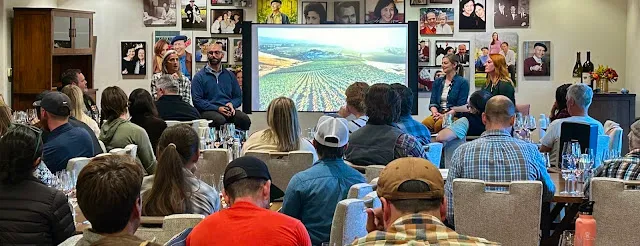
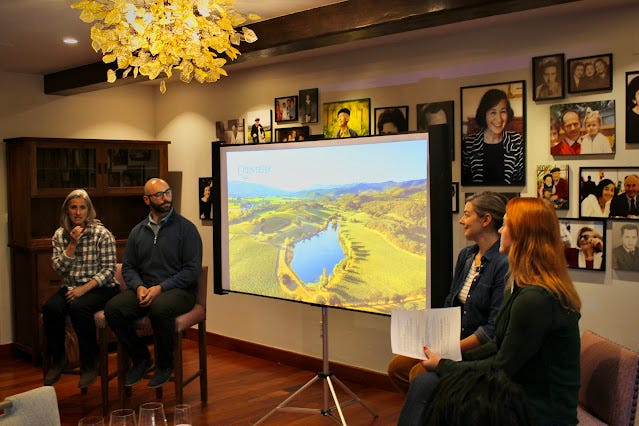
A crowd of wine grape growers and winemakers met Thursday afternoon in Rutherford to hear presentations from leading authorities in organic wine growing to better understand if organic practices make fiscal sense.
The message from the three practicing presenters–representing Napa based Grgich Hills Estate and Quintessa and Sonoma based Gloria Ferrer–was a unanimous yes.
In addition, university researcher Axel Herrera Moreno, post doc at U.C. Davis in the Lazcano lab presented cost analysis stats from the lab’s latest study at Jackson Family Wines.
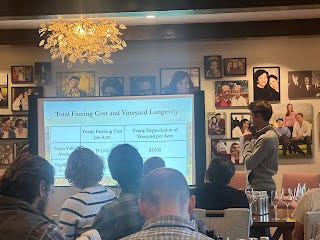
Bernat Sort Costa, regenerative organic research manager at Grgich Hills Estate, kicked things off showing that the farming costs on Grgich’s 365 acres Napa Valley vines (in five AVAs) cost less to farm than the average in Napa. Ivo Jeramaz has been providing the same data at various events. (See previous blog post here for more details.) Replanting takes place less frequently and as this is a major cost consideration, it can be potentially be the strongest reason to farm organically for some.
“Our depreciation costs are lower than half [of 150+ Napa peers] on average,” said Sort Costa.
In addition, there are intangible benefits.
“These are harder to attribute a dollar value to but what you get with regenerative farming is higher quality grapes, more flavorful, ageworthy wines…there’s no harmful chemicals in the products and most important for us, [there is better] health for our farm workers,” he said.
Grgich Hills Estate makes about 65,000 cases of all estate, all organically grown (and certified Made with Organic Grapes) wines each year.
Wine Quality Improvements Can Lead to Greater Profits: The Chateau Pontet-Canet Case Study
I personally wanted to include a bit of information here that was not part of the event, but pertains to what improvements in wine quality can lead to.
An improvement in wine quality can be a chief financial benefit, according to a Harvard Business School study of Chateau Pontet-Canet, a prestigious Bordeaux estate. In 1999, it produced 40,000 cases of grand vin (90 pts.) and 25,000 cases of second wine (86 pts.)
After organic and biodynamic conversion under Jean-Michel Comme, the estate eliminated its second wine, bringing all the grapes into its first wine–a huge financial benefit.
Two decades after converting, in 2020, Jane Anson rated the wine at 97 points.
Gloria Ferrer
In Sonoma’s Carneros, growing conditions are quite different from those at Grgich’s American Canyon, Rutherford and Calistage vineyards, but the organic farming benefits are quite similar, said Brad Kurtz of Gloria Ferrer, which is on the verge of completing organic certification on 331 acres of vines. (It takes three years of organic farming to be certified. The winery is well into year 3, having started in 2021.)
“We’ve seen the quality as we transition from conventional to organic. The quality of the wines has elevated every year, with tons of intensity on the palate,” he said, as the event attendees tasted the 2021 Royal Cuvee sparkling wine rosé. “Really long finish. Great mid palate, great mouth coat, and it’s something that we’re really proud of, and we’re really proud that every year it gets better and better as we develop our vineyards organically.”
Transitioning has really been a challenge, he said, but aided by an in house team.
“We have our own estate vineyard team. We have about 22 year round employees in the vineyards that do all of our vineyard work. We do not outsource any of our vineyard work. We have all our equipment in house. Everything is done, including harvest, in house. We do not bring outside picking crews. We hire people and use our own teams for our own harvest, and it is about 95% sparkling wine.”
Owned by Barcelona based Freixenet, Gloria Ferrer in Sonoma produces 60,000 cases of wine a year from its 331 estate acres.
“We are dealing with the challenges of organic farming. We are producing traditional method sparkling wines, which, in their own right, are very expensive to produce, and we’re able to do it organically. We’ve been able to organically farm and make these traditional method sparkling wines, and still stay a relatively affordable price point on the wholesale market… It’s something we’re really proud of–that we’re able to do this and still produce an extremely high quality product and still do it at a commercial scale.”
“As far as farming costs go, we’ve actually held our farming costs fairly steady across the last five to six years, even with the increase in the cost of inputs.”
Despite increased costs for weed control, Kurtz said, “Our farming costs have actually gone down slightly.”
Note: Around the world, other sparkling wine producers making Cava and Prosecco have made organic their calling card. Freixenet is one of the largest producers of Cava.
Grown in the Penedes region near Barcelona, Cava has new regulations that require all wines in the Guarda Superior category to be 100% organic by 2025.
Trade and Consumer Reception
Kurtz said the wines continue to increase in quality each year and vineyard tours are popular with the trade and consumers.
“We’re seeing better feedback from our consumers…we’re seeing that increase in loyalty. We’re bringing in new consumers,” he said.
He gives three tours a week to trade and consumers.
“When you start talking about organic farming and the systems involved in organic farming, their eyes light up, and they become very engaged. I think people are very interested in using these systems, whether it’s cover cropping, whether it’s grazing in the vineyards, whether it is our owl boxes, whether it’s using compost. We produce our own compost on site.”
“I take them on a walk. We walk through the vine rows. We walk up to the compost operation. I show the guys turning the compost piles. I explain why it’s important. We harvest our grapes. We take what we need from it…The skins go right back, they compost and go right back into the vineyards. It’s a whole system. So explaining these things to people, you see light bulbs go off and get them really engaged in the brand, get them engaged in the winery, and become loyal customers. And I think that’s a huge benefit.”
Napa Winemaker Perspective
Wineburg said metrics for an estate are different than for a grower. “The real metric is not cost per acre. It’s number of tons that actually make it into the blend,” she said.
“I do think that there are huge benefits in terms of resilience in each of the vines. Replanting a vineyard is the biggest cost, the most expensive thing that you can do. So if we can keep these vines in the ground for another 10, another 15 years, that’s wonderful from a cost perspective. From a quality, consistency and depth of flavor perspective, it’s even more important because vines only really come to express their terroir when they’re mature. They come into that balance, and when they are at that balance, they are more resilient. So we do believe in building farming for resilience.”
Resilience
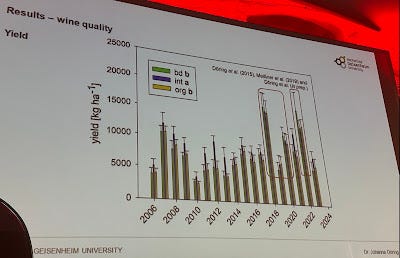
I am going to interject another point here (that was not part of the Napa Green event). A study I heard last year at the OIV sponsored Vineyards and Biodiversity conference in Avignon (highly recommended YouTube channel here with English subtitles) from Geisenheim researchers (see my blog post here) found that organic and biodynamic vines, yields in organic and biodynamic vineyards are higher than conventional in hot and dry years.
Gloria Ferrer, Continued: Grape Sales Up Due to Organic Farming
Wurtz said the organic farming has expanded the winery’s appeal not only to consumers and the trade but also to grape purchasers.
“Farming organically has opened up new clients to us, which I think is huge. It’s been a very challenging year for grape sales, as I’m sure everybody knows….But we have a lot of neighbors that have a lot of fruit that was not harvested, and we were able to move more tons. I can guarantee we were able to move more tons this year than we would have if we were not farming organically, and the price that we got for those funds was significantly higher than what everyone else was getting in our area.”
“I think that is a very easy ROI versus dropping your fruit on the ground. We’re selling it…that is a very easy equation. And if we were not farming organically, we would not have sold this fruit. Every single person we sold fruit to this year bought fruit from us because we were farming organically, and they were seeking out organically farmed fruit. And they may not be putting it on the bottle, but they are conscious of organic farming, and they understand that organic farming produces better wines.”
About Napa Green: The Napa Green 501c3 is a global leader in sustainable winegrowing, setting the highest bar for sustainability and climate action in the wine industry. Napa Green facilitates whole system soil to bottle certification for wineries and vineyards, and provides the expertise, boots-on-the-ground support, and resources to continually improve. Learn more at https://napagreen.org/participating-members/.
Anna Brittain
Napa Green
+1 805-636-3329
email us here
Visit us on social media:
Facebook
LinkedIn
Instagram
Join us on April 9, 2026 @charleskrugwinery to explore climate smart opportunities, sustainable glass, closures and more ways to green your supply chain.
We will share case studies, hear about climate-smart and alternative packaging, clarify what materials are truly recyclable, and identify new ways to divert more waste from the landfill.
With speakers from Verallia, @naturalcorkcouncil, @cork_supply, Treasury Wine Estates, @freeflowwines, @revinobottles, @keystonecapsules, Wine Industry Zero Waste Collective, @naparecycling and more!
➡️ ticket link in bio!
#winebusiness #wineindustry #supplychainmanagement

Discover four exceptional wineries united by a commitment to sustainability, community, and thoughtful hospitality.
These wineries are not only @napagreen certified but also @bcorporation certified, and through their “B Collaborative” partnership this month, they are offering a special tasting experience: wine club members receive two complimentary tastings, and non-members can enjoy a two-for-one tasting.
Learn More by visiting these wineries.
@artesawinery
@cliffamily
@spottswoodewinery
@troisnoixwine
#winetasting #visitnapavalley
Learn why Natalie Bath, Winemaker at @ruddestate considers @napagreen an important part of their commitment of land stewardship.
#SoilHealth #WomenInWine #RegenerativeViticulture
@napagreen has had a number of growers looking for organic solutions to dealing with nematodes where vines are planted. Our partners at @lallemandplantcareusa have an OMRI approved biological solution.
Learn more in this short video!
#soilhealth #vineyardmanagement #wineindustry
Join us March 17th @grgichhillsestate to connect with cover crop expert Keith Berns, with @greencoverseed, and experienced viticulturists, to leans how you can incorporate soil health practices in your vineyard!
➡️ Registration link in bio.
#soilhealth #regenerativevineyard #covercrop
What is biochar and why is it so cool?
Hear from @napa.char to learn more.
#climateaction #soilhealth #biochar
🐝 “If you build it, they will hum” - Erin Arnsteen, Western Program Coordinator @monarchjointventure
We are grateful for everyone who attended our Biodiversity in the Vineyard workshop last week! It was an amazing day @grgichhillsestate filled with bees, birds, butterflies, a community passionate about biodiversity, and experts providing resources for building biodiversity in YOUR vineyard.
#regenerativeag #biodiversity #worldwildlife #regenerativeviticulture
Join us in congratulating Megan Scott (@love.dream.breathe), our Operations Director, on 6 years at @napagreen. Megan’s positive attitude and “can do” approach to problem solving has greatly contributed to the success of Napa Green and our members.
Thanks for your work and dedication to sustainability!
📸 @brianamarieweddings
📍 @trefethenfamily
#womeninwine #womeninstem #climateaction
Thanks to the @naparegister for publishing this Climate Connection contribution from @napagreen’s Vineyard Program Director, Ben Mackie (@soilrainandhope) highlighting the biodiversity @grgichhillsestate.
If you loved this article, you’ll love our Birds, Bees & Butterflies: Biodiversity in the Vineyard workshop happening today!
#climateaction #regenerativeag #regenerativeviticulture
Friday night dinner dilemma?
Order takeout from @southsidenapa using promo code DONATE and 20% of your order will be donated to @napagreen.
It’s a win: win! You get dinner and @napagreen gets funding to contribute our impactful climate action work in Napa Valley.
Order online or preorder your Fried Chicken Friday pickup for February 27, 2026. Don’t forget to pair it with Napa Green certified wine! 🍽️ 🍷
#dineanddonate #nonprofit #napavalley
Join us Thursday, February 26 to learn about biodiversity in the vineyard.
🍇 Ivo Jeramaz, Winemaker & VP of Vineyards and Production at @grgichhillsestate, will welcome us to the beautiful property and illustrate the various implementation of habitat diversity they have undertaken at the American Canyon ranch.
🍇 Jo Ann Baumgartner & Sam Earnshaw from @wildfarmalliance will provide insight on how to maximize bird habitat and establish hedgerows to support the local ecology.
🍇 Erin Arnsteen from the @monarchjointventure will outline how pivotal vineyard acreage can be to support the dwindling Western Monarch populations.
🍇 Cori Carlson, owner of @napapastureprotein, will explain the ecological goals of grazing a vineyard.
🍇 Ruby Stahel from the @naparcd will join us to discuss the various resources that the RCD has to support habitat enhancement on Napa properties.
🍇 @soilrainandhope from @napagreen will talk about bees!
➡️ Ticket link in bio.
#biodiversity #regenerativeag #regenerativeviticulture
Learn about the herd of cattle calmly grazing the vineyards @ruddestate, contributing to soil health and biodiversity, in our latest post from @soilrainandhope.
➡️ Link in bio.
#climateaction #regenerativeag #regnerativeviticulture #soilhealth
Thanks to @naparegister and @kcuz for this great article about the @regenerativeviticulture and @napagreen #OneBlockChallenge field day @celaniwines.
We had a great time engaging with attendees about opportunities to implement regenerative practices in their vineyards!
If you’re regenerative curious or want to learn more head to the link in our bio!
#climateaction #regenerativeviticulture
Congratulations on @napagreen Vineyard Certification to @shadybrookestatewinery!
Nestled in the picturesque heart of Coombsville, Shadybrook Estate, has shown a deep commitment to regenerative viticulture and climate action. Visit to see the natural beauty of this hidden gem.
#climateaction #regenerativeviticulture #napagreen
We love the biodiversity in this @grgichhillsestate American Canyon Vineyard!
Come learn how to integrate biodiversity in your vineyard on February 26 at this workshop with @napagreen, @grgichhillsestate, @wildfarmalliance, @monarchjointventure, @napapastureprotein and @naparcd.
➡️ Ticket link in bio.
#Biodiversity #RegenerativeAg #RegenerativeViticulture
Congratulations to @rutherfordhillwinery on achieving @napagreen Winery Recertification!
At Rutherford Hill Winery, sustainability is apparent in all of their practices. The facility is 100% solar-powered and even contributes clean energy back to the local grid. Additionally, they prioritize natural solutions, like Owl Boxes and organic farming.
Visit to experience for yourself these exceptional wines that invest in our planet’s future.
#climateaction #winetasting #sustainablewine