
Sophie Arundel | The Drinks Business
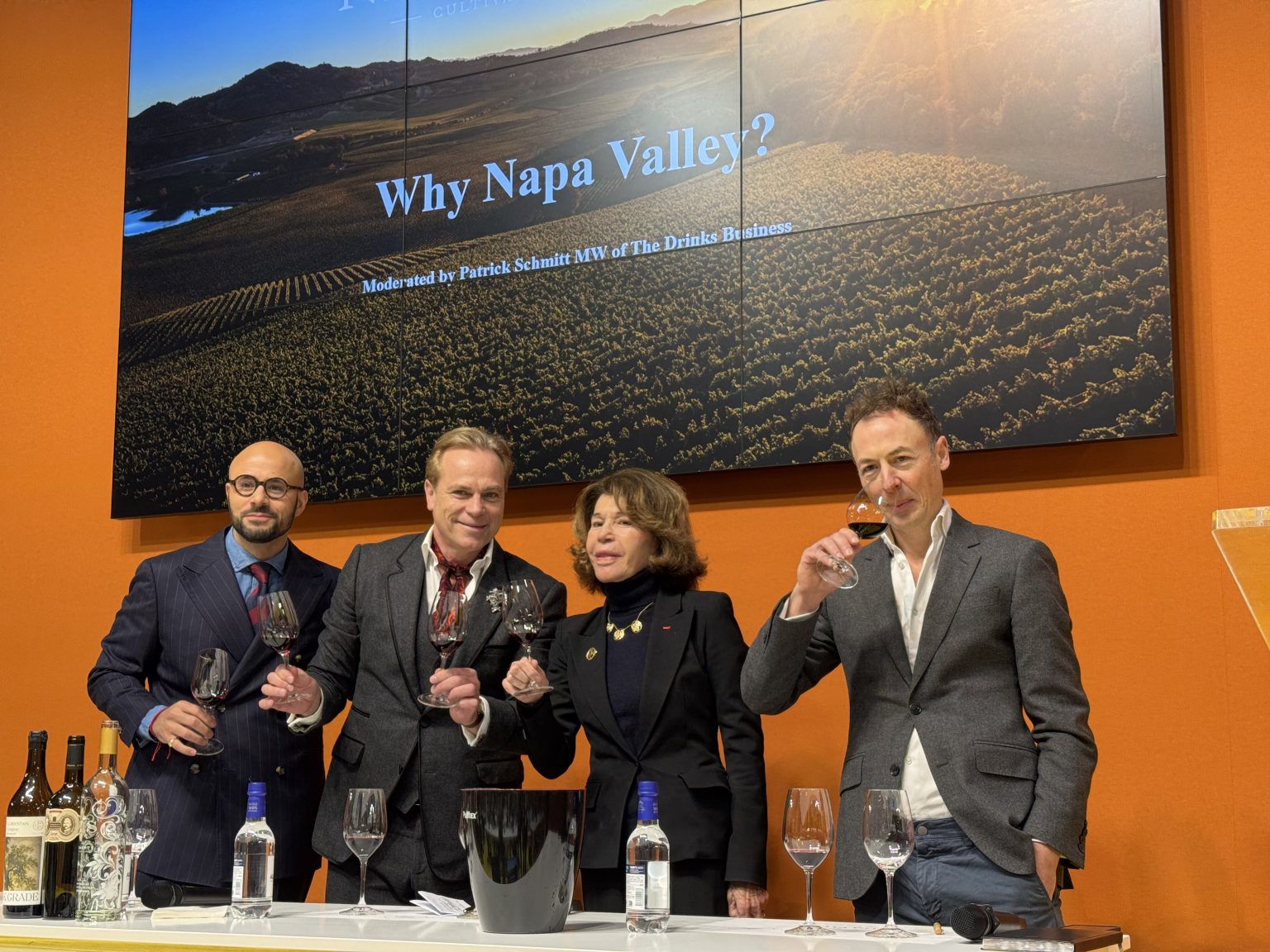
At Wine Paris last week, The Drinks Business’ Patrick Schmitt MW hosted a panel discussion exploring what draws international winemakers to Napa Valley. Joining him were Florence Cathiard, co-owner of Cathiard Vineyard in Rutherford; Jean-Charles Boisset, proprietor of Boisset Collection; and Carlton McCoy, CEO of Lawrence Wine Estates. Each had a unique perspective, having chosen Napa as the base for some of their most ambitious wine ventures.
Opening the discussion, Schmitt noted Napa’s deep-rooted international influence. “The influential names of Napa were foreign,” he remarked, citing pioneers such as Finland’s Gustave Niebaum, Germany’s Jacob Beringer, and the Rothschild family, who partnered with Robert Mondavi to create Opus One. More recently, investment has come from houses like AXA Millésimes, Antinori, and LVMH, underscoring Napa’s global stature.
Boisset, who grew up in Burgundy but has become one of Napa’s most dynamic figures, spoke of his personal draw to the region. “The University of Burgundy will tell you that the soils of Napa Valley are very unique. Similar to Burgundy, we (Napa Valley) have six of the most unique recorded soils in history,” he said. While Burgundy was his foundation, Napa offered a different kind of opportunity. “As a Frenchman, specifically coming from Burgundy, if you move to Napa, you discover Cabernet Sauvignon,” he continued, describing his enthusiasm for Rutherford’s terroir.
Cathiard echoed this sentiment, calling Napa “an old dream.” She and her husband, Daniel, purchased their Rutherford estate in 2020. “We want to be the one with a sense of place,” she said, describing their approach as blending Bordeaux refinement with Napa’s distinct character. Their Founding Brothers blend, made with fruit exclusively from their estate, was met with early acclaim. “We had a blind tasting recently in London… Jancis Robinson preferred this wine,” she revealed.
McCoy, whose company has steadily expanded its Napa holdings, emphasised the region’s long history of quality. “For me, as an American Master Sommelier, I was always very proud of wines in Napa Valley,” he said. “It’s the region that really put the US on the map for luxury great wines.” His company’s acquisitions—including Heitz Cellar and Stony Hill—are focused on preserving Napa’s heritage. “We don’t buy them to change the names. We buy them because we already love what they’re doing.”
While foreign investment in Napa has often been welcomed, Schmitt posed the question of how the panellists were received upon entering such an established region. Cathiard compared her experience to Bordeaux. “When we came to Bordeaux 35 years ago, it was very snobbish, very closed,” she recalled. “In Napa, we were welcomed much more.”
Boisset took a historical view, describing the long-standing Franco-American relationship. “There’s a genuine, authentic American-French friendship… Ocean separates us, wine brings us together,” he said. His business operates on both sides of the Atlantic, and he sees cross-cultural exchange as fundamental to progress.
“This is actually the perfect electric association. This is magic.”
McCoy, whose company recently expanded into Bordeaux with the purchase of Château Lascombes, described differing attitudes towards investment. “Americans start open-armed and warm… Whereas often the French want to see who you are first before they open the door to you,” he observed. However, he added, “Once the region recognised that we were actually there to be a part of that French culture and learn from it… they greeted us with open arms.”
For McCoy, the region’s global appeal is nothing new. “Outside investment is what made Napa Valley an exceptional region because of people’s interest and intrigue in experimentation,” he said. As a Master Sommelier, he had long admired Napa’s wines, considering it the region that put the US on the map for fine wine. “A great region is a combination of exceptional terroir and exceptional people. Napa attracted pioneers who never cut corners and understood the importance of making great wine every year.”
When the opportunity arose, McCoy partnered with the Lawrence family to acquire Heitz Cellar, a historic estate he had long respected. That investment led to others, including Stony Hill and Burgess, as family-owned wineries saw the work being done and approached them directly. “We don’t buy them to change the names. We buy them because we already love what they’re doing,” he explained. His team also sought out vineyards with untapped potential, such as Haynes Vineyard in Coombsville and Ink Grade on Howell Mountain, converting them to biodynamic farming.
McCoy sees Napa at a turning point, with a new generation bringing fresh perspectives and stylistic diversity. “There’s a bit of a renaissance in Napa,” he observed. “People are starting to understand there is more diversity in style and philosophy than what we saw in the ’90s and early 2000s.” For him, Napa’s strength has always been its openness to new ideas and investment, a tradition that continues to shape its future.
Climate change has long been a pressing issue for the wine industry, with shifting weather patterns affecting vineyard yields, ripening cycles, and overall wine styles. Rising temperatures have already begun altering traditional winemaking regions, forcing producers to adapt with new grape varieties, farming techniques, and even vineyard relocations to higher altitudes. But with the recent wildfires in California, climate change has presented an even more immediate threat.
Cathiard remarked, “Of course, there is always risk, like everywhere in the world”, taking the “high risk, high reward” outlook. However, she remained hopeful that fire prevention measures were improving. “We hope it will get better… and we cross fingers, of course.”
Boisset offered an optimistic outlook. “We have absolutely no fear of anything but for us not to evolve,” he stated. His company’s vineyards across Burgundy, Beaujolais, Napa, and Sonoma are all organic and biodynamic. “One thanks to those techniques, we make better wines, greater wines, true wines, authentic wines.” He also praised the Napa Green programme, which promotes sustainability across the region.
To conclude, Schmitt asked how much of Napa’s success today is owed to foreign investment.
McCoy was unequivocal: “Outside investment is not a new concept. It’s what made Napa Valley an exceptional region because of people’s interest and intrigue in experimentation. The Napa Valley has always been really open to outside investment—it’s our competitive edge.” He emphasised that while terroir is key, it is the people behind the wines who truly shape a region’s future. “You need to shake things up once in a while and bring people from different countries together.”
That philosophy has certainly been central to Napa’s development—and if this discussion proved anything, it’s that Napa’s global appeal shows no sign of slowing.
About Napa Green: The Napa Green 501c3 is a global leader in sustainable winegrowing, setting the highest bar for sustainability and climate action in the wine industry. Napa Green facilitates whole system soil to bottle certification for wineries and vineyards, and provides the expertise, boots-on-the-ground support, and resources to continually improve. Learn more at https://napagreen.org/participating-members/.
Anna Brittain
Napa Green
+1 805-636-3329
email us here
Visit us on social media:
Facebook
LinkedIn
Instagram
Join us on April 9, 2026 @charleskrugwinery to explore climate smart opportunities, sustainable glass, closures and more ways to green your supply chain.
We will share case studies, hear about climate-smart and alternative packaging, clarify what materials are truly recyclable, and identify new ways to divert more waste from the landfill.
With speakers from Verallia, @naturalcorkcouncil, @cork_supply, Treasury Wine Estates, @freeflowwines, @revinobottles, @keystonecapsules, Wine Industry Zero Waste Collective, @naparecycling and more!
➡️ ticket link in bio!
#winebusiness #wineindustry #supplychainmanagement

Discover four exceptional wineries united by a commitment to sustainability, community, and thoughtful hospitality.
These wineries are not only @napagreen certified but also @bcorporation certified, and through their “B Collaborative” partnership this month, they are offering a special tasting experience: wine club members receive two complimentary tastings, and non-members can enjoy a two-for-one tasting.
Learn More by visiting these wineries.
@artesawinery
@cliffamily
@spottswoodewinery
@troisnoixwine
#winetasting #visitnapavalley
Learn why Natalie Bath, Winemaker at @ruddestate considers @napagreen an important part of their commitment of land stewardship.
#SoilHealth #WomenInWine #RegenerativeViticulture
@napagreen has had a number of growers looking for organic solutions to dealing with nematodes where vines are planted. Our partners at @lallemandplantcareusa have an OMRI approved biological solution.
Learn more in this short video!
#soilhealth #vineyardmanagement #wineindustry
Join us March 17th @grgichhillsestate to connect with cover crop expert Keith Berns, with @greencoverseed, and experienced viticulturists, to leans how you can incorporate soil health practices in your vineyard!
➡️ Registration link in bio.
#soilhealth #regenerativevineyard #covercrop
What is biochar and why is it so cool?
Hear from @napa.char to learn more.
#climateaction #soilhealth #biochar
🐝 “If you build it, they will hum” - Erin Arnsteen, Western Program Coordinator @monarchjointventure
We are grateful for everyone who attended our Biodiversity in the Vineyard workshop last week! It was an amazing day @grgichhillsestate filled with bees, birds, butterflies, a community passionate about biodiversity, and experts providing resources for building biodiversity in YOUR vineyard.
#regenerativeag #biodiversity #worldwildlife #regenerativeviticulture
Join us in congratulating Megan Scott (@love.dream.breathe), our Operations Director, on 6 years at @napagreen. Megan’s positive attitude and “can do” approach to problem solving has greatly contributed to the success of Napa Green and our members.
Thanks for your work and dedication to sustainability!
📸 @brianamarieweddings
📍 @trefethenfamily
#womeninwine #womeninstem #climateaction
Thanks to the @naparegister for publishing this Climate Connection contribution from @napagreen’s Vineyard Program Director, Ben Mackie (@soilrainandhope) highlighting the biodiversity @grgichhillsestate.
If you loved this article, you’ll love our Birds, Bees & Butterflies: Biodiversity in the Vineyard workshop happening today!
#climateaction #regenerativeag #regenerativeviticulture
Friday night dinner dilemma?
Order takeout from @southsidenapa using promo code DONATE and 20% of your order will be donated to @napagreen.
It’s a win: win! You get dinner and @napagreen gets funding to contribute our impactful climate action work in Napa Valley.
Order online or preorder your Fried Chicken Friday pickup for February 27, 2026. Don’t forget to pair it with Napa Green certified wine! 🍽️ 🍷
#dineanddonate #nonprofit #napavalley
Join us Thursday, February 26 to learn about biodiversity in the vineyard.
🍇 Ivo Jeramaz, Winemaker & VP of Vineyards and Production at @grgichhillsestate, will welcome us to the beautiful property and illustrate the various implementation of habitat diversity they have undertaken at the American Canyon ranch.
🍇 Jo Ann Baumgartner & Sam Earnshaw from @wildfarmalliance will provide insight on how to maximize bird habitat and establish hedgerows to support the local ecology.
🍇 Erin Arnsteen from the @monarchjointventure will outline how pivotal vineyard acreage can be to support the dwindling Western Monarch populations.
🍇 Cori Carlson, owner of @napapastureprotein, will explain the ecological goals of grazing a vineyard.
🍇 Ruby Stahel from the @naparcd will join us to discuss the various resources that the RCD has to support habitat enhancement on Napa properties.
🍇 @soilrainandhope from @napagreen will talk about bees!
➡️ Ticket link in bio.
#biodiversity #regenerativeag #regenerativeviticulture
Learn about the herd of cattle calmly grazing the vineyards @ruddestate, contributing to soil health and biodiversity, in our latest post from @soilrainandhope.
➡️ Link in bio.
#climateaction #regenerativeag #regnerativeviticulture #soilhealth
Thanks to @naparegister and @kcuz for this great article about the @regenerativeviticulture and @napagreen #OneBlockChallenge field day @celaniwines.
We had a great time engaging with attendees about opportunities to implement regenerative practices in their vineyards!
If you’re regenerative curious or want to learn more head to the link in our bio!
#climateaction #regenerativeviticulture
Congratulations on @napagreen Vineyard Certification to @shadybrookestatewinery!
Nestled in the picturesque heart of Coombsville, Shadybrook Estate, has shown a deep commitment to regenerative viticulture and climate action. Visit to see the natural beauty of this hidden gem.
#climateaction #regenerativeviticulture #napagreen
We love the biodiversity in this @grgichhillsestate American Canyon Vineyard!
Come learn how to integrate biodiversity in your vineyard on February 26 at this workshop with @napagreen, @grgichhillsestate, @wildfarmalliance, @monarchjointventure, @napapastureprotein and @naparcd.
➡️ Ticket link in bio.
#Biodiversity #RegenerativeAg #RegenerativeViticulture
Congratulations to @rutherfordhillwinery on achieving @napagreen Winery Recertification!
At Rutherford Hill Winery, sustainability is apparent in all of their practices. The facility is 100% solar-powered and even contributes clean energy back to the local grid. Additionally, they prioritize natural solutions, like Owl Boxes and organic farming.
Visit to experience for yourself these exceptional wines that invest in our planet’s future.
#climateaction #winetasting #sustainablewine